Posts

Showing posts with the label 360 Video

Archaeology 360: Kilmacduagh Monastery. Part III: The Round Tower and Cathedral
Image
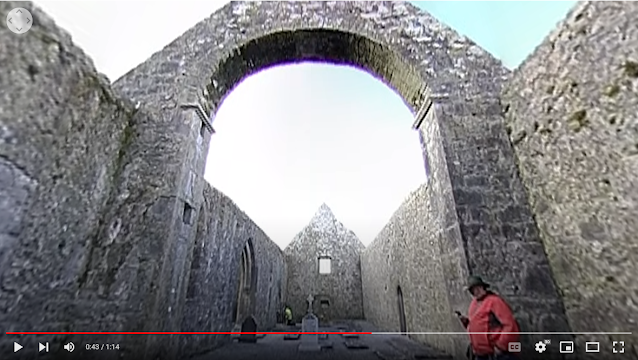
If you've travelled with me on this 3D, 360-degree tour of Kilmacduagh, Co. Galway, you’ll have seen the O'Heyne's Church [ here ] and The Glebe House & Temple Mary [ here ] (and if not, why not? … go back & check them out … I’ll wait!). Well, now it’s time to move on to the concluding part and visit the Round Tower and Cathedral – the twin jewels of this delightful monastic site. The most striking element of the site is obviously the Round Tower. It dates to the 12th century and, standing 34m tall, it is the tallest surviving round tower. Famously, the tower deviates from the vertical and is often compared to the Leaning Tower of Pisa, mostly by people who’ve never been to Italy or seen a picture of just how much either tower actually leans. The Cathedral building has a long and relatively complex history of construction, expansion, and renovation. It appears that the west wall of the Nave is the oldest surviving portion of the building and a blocked doorway (11th-...
Archaeology 360: Kilmacduagh Monastery. Part I: O'Heyne's Church

Image
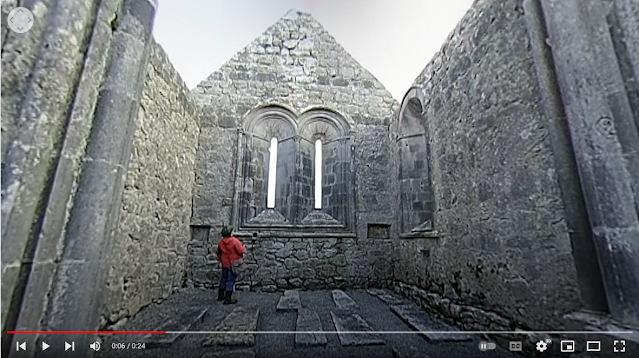
The monastery of Kilmacduagh, Co. Galway, is believed to have been founded in the 7th century by St Colman. None of the surviving buildings date to that early period, but many fine examples of medieval architecture survive here. I've broken this tour down into several segments, the first one being a visit to the 13th century remains of the O'Heyne's Church [ Irish Stones ]. I’ve compiled the tour into a consecutive YouTube playlist [ here ] , or you can access each video clip individually here: Part I: Outside, to the NE [0:23] Part II:  Outside the East Window   [1:35] Part III: External, to the S [1:03] Part IV: Internal, by the Chancel Arch [0:24] You can view this 360-degree video on an ordinary browser or on the dedicated YouTube app for your smartphone. However, for best results we recommend the more immersive experience that comes with an Oculus/Google Cardboard headset. Please feel free to  Like  and  Share  the video and  Subscribe ...

Archaeology 360: St. Patrick's High Cross, Carndonagh, Co Donegal

Image
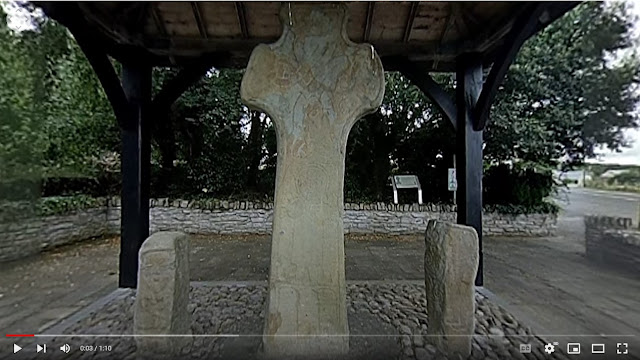
First there were cross slabs (slabs of stone with crosses carved on them, like at Fahan Mura ) and eventually there were the great High Crosses (like at Kells, Co. Meath). But … somewhere between the two lies St Patrick’s Cross at Carndonagh, Co. Donegal. Although art historians still argue over the dating of the sequence, it is generally thought that the cross at Carndonagh dates to the middle of the 7 th century. The eastern face is decorated with ribbon interlace. The upper portion of the western face is filled with a Greek cross, in similar ribbon interlace while the lower stem bears a depiction of Christ in low relief. Flanking the cross are two pillar stones decorated with human figures. The pillar to the south of the cross had a carving of a figure with a bell that might be a bishop or pilgrim. Another face of the same stone bears an unusual figure, apparently bearing a fine set of horns. The northern pillar has depictions of a warrior (with shield) and King David (with harp). ...

Archaeology 360: Temple of Deen Court Tomb, Co Donegal

Image
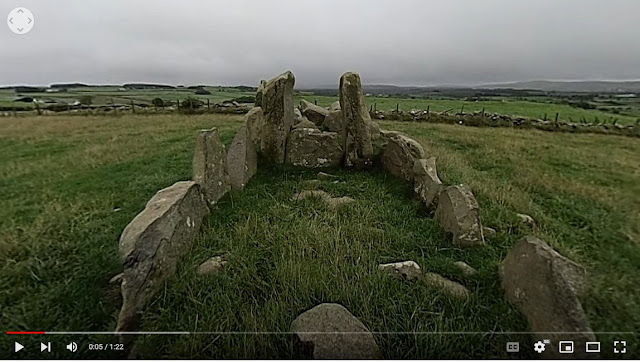
Court tombs are typically composed of a stone-built burial chamber, paired with an open courtyard (hence the name). Built during the 4 th millennium BC, around 390 examples survive in Ireland [ Wiki ]. The example at Larahirrel, outside the village of Bocan, is pretty well preserved with an identifiable court and chamber stones surviving in situ , even if most of the cairn material is long gone. The surviving upright stones are spectacular and the windswept hilltop it sits on gives impressive views across the countryside in all directions. I didn’t visit during the nicest weather, but you can still get a sense of the great views across the landscape as well as the beauty of the site itself. I’ve compiled the tour into a consecutive YouTube playlist [ here ], or you can access each video clip individually here: Part I: Outside, to the SW [1:16] Part II: Outside, to the NW, by the court [1:23] Part III: Inside the court [1:23] Part IV: Outside, to the N [1:03] Part V: In...

Archaeology 360: Fahan Mura, Co Donegal

Image
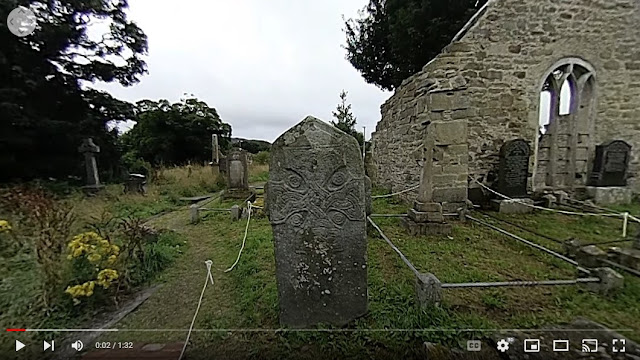
At first glimpse, there’s little remarkable about Fahan Mura graveyard. Sure, there was a monastery here from the 6 th century, but nothing identifiable survives above ground and the standing ruins date to the 16 th and 17 th centuries. Throw a stone in rural Ireland and it has a decent chance of landing in a similar churchyard. What sets this site apart, however, is the absolutely magnificent 7 th century cross-slab of St Mura (though some argue that it slightly later in the sequence of ancient cross carving). There is an interlaced long-stemmed, Latin, cross on both sides, though on the west face there are (difficult to see) representation of two human figures. It’s debatable who they might represent, but the local tradition that one of them is old Mura himself has much to recommend it. Quite apart from its artistic merit, the Fahan cross-slab is of importance as it is one of only two ancient examples of continuous Greek script surviving from early Ireland. In this instance the s...

Archaeology 360: Kilfenora Cathedral & Crosses, Co. Clare

Image
1998: Rowan Atkinson and assorted clerics on east window of chancel There are many fine and gorgeous archaeological and historic sites of all ages in the Burren, Co. Clare, but among my personal favourites is Kilfenora. Very little is known of St. Fachanan beyond the tradition that he founded the first church here in the 6 th century and that he is remembered as the first Bishop of Kilfenora. Whatever the truth in the tradition, no buildings survive from that early phase. In any event, Kilfenora wasn’t a particularly important religious centre until the mid-12 th century when it was upgraded to being a Diocese and much of the standing architecture belongs to the decades immediately after this increase in status. The western, nave, portion of this late-12 th to early 13 th century building is still used as a Church of Ireland place of worship, but the chancel is unroofed and boasts a finely carved window. The latter is decorated with several clerics, at least one of which bears more...

Archaeology 360: Trim Castle, Co. Meath

Image
Trim Castle sits on the banks of the River Boyne and is mostly famous as one of the locations where Mel Gibson's 1995 movie Braveheart was set. At various times in the movie Trim stood in for the City of York and parts of London. This is unfortunate as the castle should be better know as one of the locations where Samuel Fuller's 1980 movie  The Big Red One , starring Lee Marvin and Mark Hamill, was filmed. Here the castle stands in for one in Germany during World War II. Even then, it only appears in the 2004 version of the movie known as 'The Reconstruction' that tried to better recreate Fuller's vision of the movie, before it was unsympathetically re-edited by Warner Bros., but I digress. The castle has a long building history that stretches from the 12th century onwards. You can read all about it (and the movies) on the Wiki page [ here ]. I’ve compiled the tour into a consecutive YouTube playlist [ here ], or you can access each video clip individually here: P...

Archaeology 360: The Hill of Tara, Co. Meath

Image
  I’ve taken my 360-degree 3D Vuze camera to some sites that are interesting and important to me, but they’re hardly well known. That changes now! A while back I had the opportunity to go to Tara, Co. Meath and play around up there. Unfortunately, the camera wasn’t as excited to be on this important site as I was, and insisted on repeatedly cutting out after only a sort amount of time filming. For all that, I think they resulting short clips are worth presenting to give a feeling for the place. If you don’t already know, the Hill of Tara is an ancient ceremonial and burial site and I will not attempt to paraphrase the entire Wiki page here, but go have a read for yourself [ here ]. I’ve compiled the tour into a consecutive YouTube playlist [ here ], or you can access each video clip individually here: Standing Stones in Churchyard Pt. I [0:15] Standing Stones in Churchyard Pt. II [0:30] Ráth Chaelchon (Sloping Trenches) [0:13] Banqueting Hall [0:13] Ráth na Seanadh ...

Archaeology 360: Killora Church & Graveyard, Co. Galway

Image
There’s something of an inevitability about it … if I start talking about Killogilleen [ here ], you can be sure that I’ll soon get around to blathering on about Killora. So, as I was pottering about east Galway with my 3D 360 Vuze camera, it was no surprise that I’d follow up my visit to Killogilleen with one to Killora. What I say about one I repeat about the other … there’s noting ostensibly special about these sites – to a greater or lesser degree they’re pretty much typical of rural west of Ireland church sites. Both Killora & Killogilleen have standing church ruins dating from around the late 15 th century, with tantalizing hints of earlier activity, possibly going back to the 13 th century. What sets them apart from others is that fact that they’ve been the focus of (sporadic) research for nearly 30 years. I’m reminded of an episode of the TV show QI that asked the question ‘Where Is the Best Place to Discover A New Species?’ [ here ]. In amongst answers both comedic and ...

Archaeology 360: Killogilleen Church & Graveyard, Co. Galway

Image
There’s probably nothing to really recommend a visit to Killogilleen church and graveyard, near Craughwell, Co. Galway. It’s rather typical of traditional burial sites in rural west of Ireland … there’s a ruined 15 th century church, there’s dated memorials going back to the 1600s, and continuing as late as the 1980s. You seen one you seen ‘em all! Right? … not this time! Back in 1996 I was employed on a F Á S Scheme to oversee the cutting back of the ivy and a general cleanup of the site. I was also tasked with compiling a book of the gravestone inscriptions on the site [ available here ]. One day in July I got called over to see ‘something interesting’ that had just been found … I’d have a few of these calls and for a variety of reasons. Some were cool architectural fragments that were reused as grave markers, some were just rocks (used as grave markers) … in a graveyard? Who'd believe it? I think it’s fair to say that I wasn’t filled with tingling anticipation at this latest di...

Archaeology 360: Tullyhogue Fort, Co. Tyrone

Image
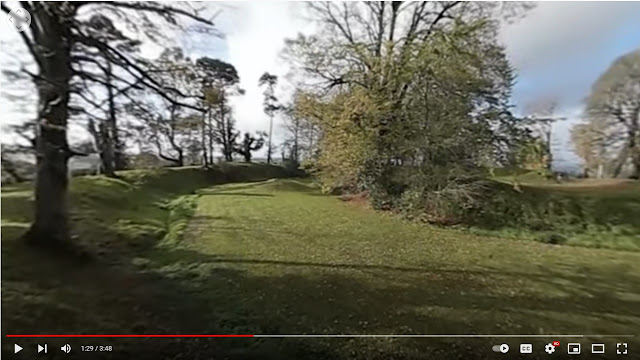
I don't really keep a list of archaeological sites that I'd love to see fully excavated, but if I did Tullyhogue Fort, Co. Tyrone would be up there! Today, it's a series of grassy banks with a wonderfully waterlogged ditch. It would be a pain to excavate safely, but the potential for well preserved organic artefacts and environmental evidence could be huge! The site probably started off in the prehistoric period (it's a hill in Tyrone - I defy you to not find evidence of prehistoric activity!), and by the Early Medieval a ringfort/rath had been built there. It was, evidently, an important place in the landscape as each new O'Neill was obliged to schlep over to Tullyhogue from Dungannon to be formally inaugurated by an O'Cahan wielding a shoe. The origins and significance of the 'shoe ritual' are obscure, but appear to derive from the 1979 epic movie Monty Python's Life of Brian. OK ... I'm joking, but have you read the nonsense some prehistorians...

Archaeology 360: Portora Castle, Co. Fermanagh

Image
I've been busy ... busy being happy. Busy being happy and not writing ... I've been making gin [ here ] I've been making bowls [ here ] I've even got some bees [ here ] but most of all, I've been watching movies [ here ] ... so many movies! However, it's time to start releasing some of the movies that I've made of archaeological sites around the countryside. With that in mind, here's a meditative wander through Portora Castle, Co. Fermanagh. Portora is a Plantation Period castle and was built around 1612. I've written a little about it before & published some 3D photos, as well as recounted my part in the excavation of the site back in 1997 [ here ]. For now, enjoy this soothing, immersive 360 degree video  tour around this peaceful castle on the shores of Lough Erne ... You can view this 360-degree video on an ordinary browser or on the dedicated YouTube app for your smartphone. However, for best results we recommend the more immers...

Archaeology 360: Monea Castle, Co Fermanagh

Image
Monea castle is one of Northern Ireland's iconic castles. It lies in gently undulating countryside, about 4 km to the west of Lough Erne. The major building work of the castle was carried out between 1616 and 1618. However, a Survey of 1619 noted that it was 'a strong Castle of Lime & Stone, being 54ft long & 20ft broad; but hath no Bawne unto it'. This 'Bawn', or outer defensive wall, was not completed until 1622. Its designer and first owner was Scotsman, Malcolm Hamilton, who started off as the Rector of Devenish, before being appointed Chancellor of Down in 1612. Things clearly went well for him as he was made archbishop of Cashel in 1623. But not too well, as Wikipedia records that in 1629 he 'died of an unknown infectious disease', which seems somehow unsettling ... but mostly for Malcolm! The subsequent history of the site has it passing back & forth between Irish and Colonist control for much of the 17th century. It appears to have burnt ...

Archaeology 360: Errigal Keerogue, Co. Tyrone

Image
Dr Chris Lynn & Giant Pillar of Light at Errigal Keerogue, 2000 Historical sources suggest that a  St  Chiarog founded a chri stian  monastery here in the 6th century, but  there has probably a been a religious site of some description on this esporgent hill in rural Tyrone for as long as there have been humans to want religion. Today it is a quiet spot, quite a bit off the main road, dominated by the ruin of a late medieval church perched on top of the hill. Inside the church is a replica of a medieval tombstone, possibly representing a knight. However, the real treasure of this fantastic little site stands just to the west of the church building -  an unfinished High Cross of Early Medieval date.  The megalithicireland.com site describes is as having 'Short stubby arms ... slightly protruding from an unpierced ring'. In the right light you can see a set of incised lines marking a ring and concave arms on on the eastern face. On the opposite (west...

Archaeology 360: Killadeas, Co Fermanagh

Image
  Killadeas is a little town in Co. Fermanagh, on the eastern shore of Lough Erne. In the little graveyard of the modern Church of Ireland church. Our little 360-degree tour starts near the large upright Early Christian Cross inscribed stone (with possible bullaun mortar holes on its the back), moves on the pillar/standing stone, past the cross-base (that looks like a large stone donut set on edge in the ground*), and onto the ‘Bishop’s Stone’. The latter has a depiction of a bishop – identified by his bell and crozier – on one broad side and a ’grotesque’ mask on a narrow side. The stone is dated to the Early Christian/Early Medieval period, around the 9th to 10th centuries. When the light is just right and the shadows fall in a particular way, the bishop appears to have a slight wistful smile and almost a twinkle in his ancient eye. I’ve visited this site on many occasions over the years and am always taken by his exquisite, pointy topped shoes. Taken together, these remnants i...