Posts

Showing posts with the label Chapple

Archaeology 360: Trim Castle, Co. Meath

Image
Trim Castle sits on the banks of the River Boyne and is mostly famous as one of the locations where Mel Gibson's 1995 movie Braveheart was set. At various times in the movie Trim stood in for the City of York and parts of London. This is unfortunate as the castle should be better know as one of the locations where Samuel Fuller's 1980 movie  The Big Red One , starring Lee Marvin and Mark Hamill, was filmed. Here the castle stands in for one in Germany during World War II. Even then, it only appears in the 2004 version of the movie known as 'The Reconstruction' that tried to better recreate Fuller's vision of the movie, before it was unsympathetically re-edited by Warner Bros., but I digress. The castle has a long building history that stretches from the 12th century onwards. You can read all about it (and the movies) on the Wiki page [ here ]. I’ve compiled the tour into a consecutive YouTube playlist [ here ], or you can access each video clip individually here: P...

Thanks for Reading! | The Top 10 posts of 2019

Image
As we come to the last days of the old year I’ve been having a look at what people enjoyed reading. Here’s my Top 10 most-read posts of 2019: 10: The Petrie Museum | Overview 9: Co Tyrone: Archaeological Objects at The British Museum 8: Co Kildare: Archaeological Objects at The British Museum 7: I have always imagined Paradise as a kind of library: some books of enduring importance (to me) 6: The Tauntaun of Fermanagh. 17th Century Cryptids in West Ulster 5: Co Louth: Archaeological Objects at The British Museum 4: Co Antrim: Archaeological Objects at The British Museum Part III 3: Don’t steal, don’t lift: Thoughts on the consequences of plagiarism 2: I got a letter on a lonesome day: The anatomy of a dispute with the Keeper of Irish Antiquities 1: Archaeological Archives for Sale! Buy it or bin it! To this list, I’d add three further posts for your consideration that I think are worth a read but didn’t make the top 10. John de...

I have always imagined Paradise as a kind of library: some books of enduring importance (to me)

Image
If you’ve been about social media for a while you’ve probably encountered one of these ‘upload six books to Facebook, no discussion, just covers’ things. There’s the usual stipulation that you should then tag someone else to do the same. I’ve been invited/borderline bullied to do these on a number of occasions and I’ve always resisted, mostly because I just couldn’t be bothered and probably don’t have the self-discipline to see it through over the course of a week. I’m also unlikely to be able to narrow it down to just six books. On New Year’s Eve, prior to the celebrations kicking off, I spent a delightful afternoon restocking the shelves of my personal library. I’ve been working on a research project that has required a rather large amount of reference checking (archaeology is just so glam!) and every time I’ve needed a book, I’ve retrieved it from my ground-floor library and brought it to my garret office. And there it has invariably stayed. My intentions were good – I certainl...

A gold lunula from Rossmore Park, Co. Monaghan

Image
Continuing my series of images of artefacts from the National Museum of Ireland, I’d like to highlight the beautiful gold lunula from Rossmore Park,  Drumbanagher, Co. Monaghan.  Conventionally, these artefacts are divided into the groups know as ‘Classical’, ‘Unaccomplished’, and ‘Provincial’. The Classical variety show the greatest skill in their manufacture and the greatest symmetry in their decoration. The Rossmore Park is a particularly fine example of the Classical type and is thought to date to around 2000 BC. It is often thought that, given the probability that they’d be uncomfortable to wear, lunulae may have been worn infrequently – just on special occasions where the display of status and power was important. I would parallel this with many women’s approach to wearing high heels – rather uncomfortable and just for special occasions and/or when power and status displays are needed. I want to deliberately make that link between women and power because (des...

‘The excavation was a financial success’ | Irish Commercial Archaeology in 2015

Image
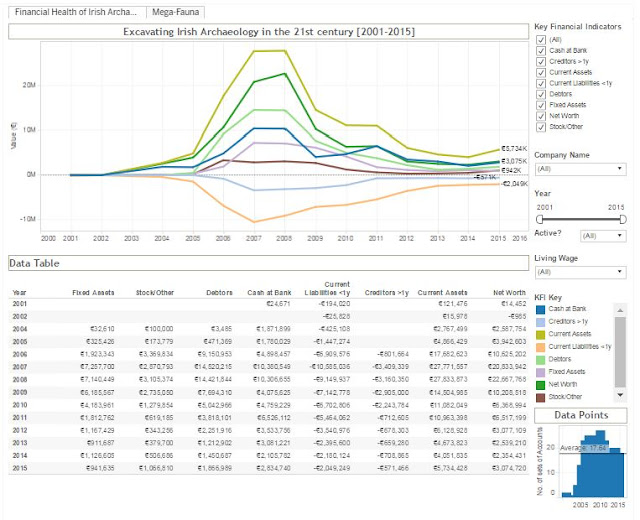
Screenshot of the Tableau Dashboard. Available [ here ] and at the end of this post Background Archaeologists are supposed to be rather good at digging … out in the field it’s quite a bit of what we do. When I left field archaeology in 2011 it was, I suppose, inevitable that I would find something else to delve and dig into. One of the topics that has engaged my attention in recent years is the reconstruction of the financial histories of individual archaeological consultancies to create an impression of the sector as a whole, based on a few publicly available ‘Key Financial Indicators’. The process started with an examination of Northern Ireland’s four archaeological consultancies for the period from 2007-2013 [ here ] and, while imperfect, was sufficient to plot much of the post-2008 collapse of the industry, even if the 2013 data was only for a single company. A second post [ here ] updated the dataset with the 2013 financial details of two further companies. My original p...

Three Sides Live | Professor Etienne Rynne Lectures | October 1994 | Part III

Image
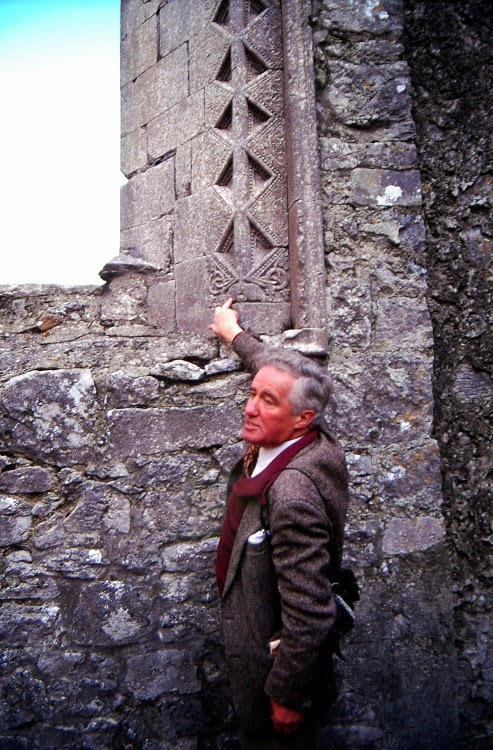
[** If you like this post, please make a donation to the IR&DD project using the secure button at the right. If you think it is interesting or useful, please re-share via Facebook, Google+, Twitter etc. To help keep the site in operation, please use the amazon search portal at the right - each purchase earns a small amount of advertising revenue **] < Part I | Part II Prof. Etienne Rynne at the decorated east window of  Annaghdown Cathedral ,  Co. Galway, in 1996 (© Chapple Collection) In this, the third and final lecture, Prof. Rynne tackles ‘the big three’ of Irish Early Christian metalwork: The Tara Brooch , The Ardagh Chalice , and the Derrynaflan hoard . All of his obituaries noted that he accompanied the Ardagh Chalice to the British Museum when it was disassembled for cleaning and restoration. This gave him remarkable insight into the manufacture of the piece which, unfortunately, he never got around to publishing. While never filling the void, I...