Posts

Showing posts with the label Donegal

Archaeology 360: St. Patrick's High Cross, Carndonagh, Co Donegal
Image
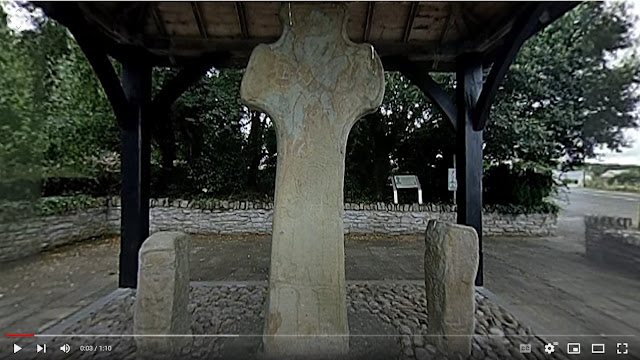
First there were cross slabs (slabs of stone with crosses carved on them, like at Fahan Mura ) and eventually there were the great High Crosses (like at Kells, Co. Meath). But … somewhere between the two lies St Patrick’s Cross at Carndonagh, Co. Donegal. Although art historians still argue over the dating of the sequence, it is generally thought that the cross at Carndonagh dates to the middle of the 7 th century. The eastern face is decorated with ribbon interlace. The upper portion of the western face is filled with a Greek cross, in similar ribbon interlace while the lower stem bears a depiction of Christ in low relief. Flanking the cross are two pillar stones decorated with human figures. The pillar to the south of the cross had a carving of a figure with a bell that might be a bishop or pilgrim. Another face of the same stone bears an unusual figure, apparently bearing a fine set of horns. The northern pillar has depictions of a warrior (with shield) and King David (with harp). ...
Archaeology 360: Temple of Deen Court Tomb, Co Donegal

Image
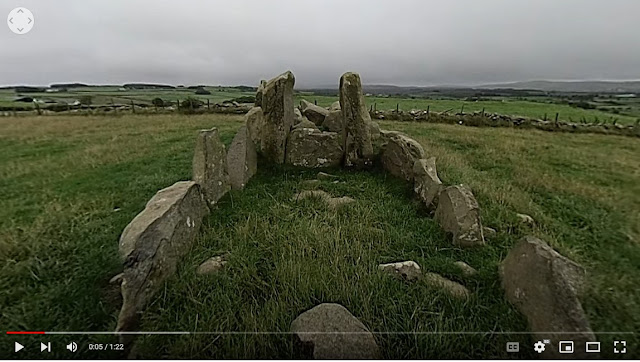
Court tombs are typically composed of a stone-built burial chamber, paired with an open courtyard (hence the name). Built during the 4 th millennium BC, around 390 examples survive in Ireland [ Wiki ]. The example at Larahirrel, outside the village of Bocan, is pretty well preserved with an identifiable court and chamber stones surviving in situ , even if most of the cairn material is long gone. The surviving upright stones are spectacular and the windswept hilltop it sits on gives impressive views across the countryside in all directions. I didn’t visit during the nicest weather, but you can still get a sense of the great views across the landscape as well as the beauty of the site itself. I’ve compiled the tour into a consecutive YouTube playlist [ here ], or you can access each video clip individually here: Part I: Outside, to the SW [1:16] Part II: Outside, to the NW, by the court [1:23] Part III: Inside the court [1:23] Part IV: Outside, to the N [1:03] Part V: In...

Archaeology 360: Fahan Mura, Co Donegal

Image
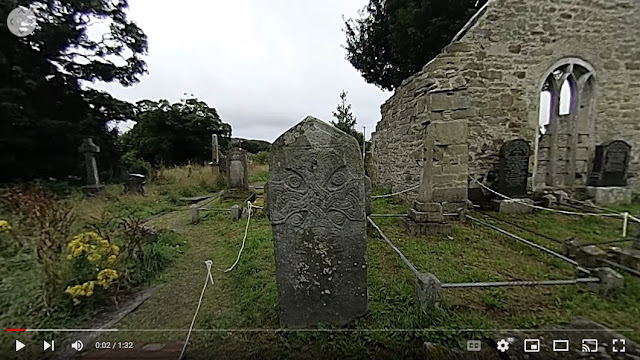
At first glimpse, there’s little remarkable about Fahan Mura graveyard. Sure, there was a monastery here from the 6 th century, but nothing identifiable survives above ground and the standing ruins date to the 16 th and 17 th centuries. Throw a stone in rural Ireland and it has a decent chance of landing in a similar churchyard. What sets this site apart, however, is the absolutely magnificent 7 th century cross-slab of St Mura (though some argue that it slightly later in the sequence of ancient cross carving). There is an interlaced long-stemmed, Latin, cross on both sides, though on the west face there are (difficult to see) representation of two human figures. It’s debatable who they might represent, but the local tradition that one of them is old Mura himself has much to recommend it. Quite apart from its artistic merit, the Fahan cross-slab is of importance as it is one of only two ancient examples of continuous Greek script surviving from early Ireland. In this instance the s...

Archaeology 360: Rathmullan Priory, Co. Donegal

Image
In this, the concluding piece from the Chapple Family’s sojourn in the wonderful county of Donegal, we stopped off at Rathmullan Priory. I would point out that we only got there by accident – we never actually intended to go. We been staying in Buncrana and had decided to head further west to my old stomping grounds around Dunfanaghy and Portnablagh. As I detailed in my previous post [ here ], I’d managed to escape the clutches of my beach-loving family and spend some time wandering around the secluded ruins of Doe Castle. Well, by the time I returned from the castle, everyone was pretty much exhausted from playing on the beach. We slowly packed up, made our way back to the car, turned on the GPS and headed for home. A well-prepared, thoughtful driver would have been aware of the GPS settings and, perhaps, plotted some way points to ensure that the correct route was followed. I, on the other hand, simply turned it on, set the address for Buncrana and trusted to whatever small gods exis...

Archaeology 360: Doe Castle, Co. Donegal

Image
In the previous instalment to this series of 360-degree video posts I took you to see the remains of the Early Medieval house at Rinnaraw [ here ]. The back story to this was that I’d left the rest of the family on the beach at Portnablagh and walked back to Rinnaraw on my own. Partly, this was because I didn’t think they’d be all that interested in such an apparently ‘slight’ monument that would require trudging across a field to go see. The other part was that I felt the visit should be a solo encounter with the site and an opportunity for personal reflection and meditation, which is hard to achieve when each of the Chapples Minor are trying to throw the other off the edge of the precipice. All went well. I completed my filming and ruminations in perfect peace and eventually dandered back to where the rest of the family were on the beach. I had hoped that all would have run through their fascination with sand and seawater by now and we’d soon be on our way to see more archaeology. Tu...

Archaeology 360: Early Medieval House, Rinnaraw, Co Donegal

Image
Anyone following this series of posts will be aware that most concentrate on relatively well known and accessible monuments, but for this one I'm taking a different approach. I’m going to be frank – there’s probably little reason to visit this site in person. It’s on no ‘must see’ list, nor does it come highly recommended in any guide book, but for all that, it’s special to me! This is Rinnaraw , a little Early Medieval house site, overlooking Sheephaven Bay. It is overgrown and quiet now, but it was excavated by Dr Tom Fanning from 1987 to 1992 [ Reports Here | Final Publication ] and was the scene of my very first archaeological excavation [ Reminiscences Here ].   I worked there in 1989 and hadn’t been back since. Watching the images now, I’m immediately thrown back to the sounds and dedicated activity of over 30 years ago and it has given me a place to lightly meditate on my life and the passing years. I realise that very few reading this blog post will share these ancient...

Archaeology 360: WWII Lookout Post, Horn Head, Co Donegal

Image
As part of our Summer excursion to Donegal, I wanted to bring the family to see the incredible views from Horn Head. Back in 1989, when I was working at Tom Fanning's excavation at Rinnaraw , we used to walk out here of an evening. For the unwary, I would note that there are two different routes on this little jut of land. One brings you to this World War II lookout post with modest parking and spectacular views. The other fork in the road will bring you to equally gorgeous vistas, but will involve driving along a road that is literally terrifying - precipitous drops, no hard shoulder, and definitely zero space to allow two cars to pass. This is the route we took first and I'm not too proud to admit that I stayed in the car while the more adventurous members of the family walked about calmly outside like it was perfectly safe and I wasn't totally over reacting! anyway, once we got on the right path, parked and got to the crest of this little rise, the whole of Horn Head was...

Archaeology 360: Grianán of Aileach, Inishowen, Donegal

Image
In 2020 the question ‘Where did you go on holiday?’ is a more potentially loaded one than I’ve ever known before. Back in February and March we had plans! Oh such plans! They involved airplanes and international travel, but they were not to be. Along came Covid-19 and all hope of such distant delights seemed to evaporate and vanish like a haze on a misty morning – or some other dollop of purple prose. We had the time to take and desire to get away from home, so we hunted around for a place to stay with access to good beaches and cool archaeology. That’s why we set forth across the border for the distant delights of Donegal. It might not come as a huge surprise to learn that I brought the 360-degree camera along for the trip and that the following series of posts all concern our family’s adventures in that gorgeous, beautiful county.   Our first stop on our trip was to see the magnificent Grianán of Aileach. In all my years in archaeology, I’d never managed to get to get to see ...

Co Donegal: Archaeological Objects at The British Museum

Image
The British Museum holds 18 items identified as coming from Co Donegal, along with one further item identified as coming from either Antrim or Donegal. The majority of these (6) are assigned to the Neolithic/Bronze Age, followed by the Early Medieval (5), and Bronze Age (4) periods. The most common object types are axes, bell-shrines, knives, knives(?)/blades(?), and pins (2 each). Only two material types are represented in this assemblage: Metal (12) and Stone (7). < Table of Contents Neolithic/Bronze Age: Stone items Donegal axe 18900215.100 Polished stone axe, large http://britishmuseum.org/research/collection_online/collection_object_details.aspx?objectId=1392177&partId=1 Letterkenny axe 19890301.143 Polished stone axe with slightly damaged rounded butt. http://britishmuseum.org/research/collection_online/collection_object_details.aspx?objectId=1372130&partId=1 Glenhead knife (?); blade (?) 19641206.217 Flint knife or backed ...