Posts

Showing posts with the label Etienne Rynne

Thanks for reading! | The Top 10 posts of 2017

Image
Over the course of 2017 I’ve published some 63 posts of varying kinds, that garnered just under 70,000 views. As the year is drawing to a close, I just wanted to thank everyone who has read, shared, and (hopefully) enjoyed some of the content along the way. For those who missed out and would like to catch up, here are the Top 10 posts from 2017, plus a final, end-of-year plug for two posts that I really enjoyed writing that, I think, should have been a bit more widely read than they were. Again, my thanks for reading in 2017 … I’m already working on a large number of posts for 2018, so I hope to catch your interest with some of those too! 10) Glendalough: St Saviour's Priory 9) Ain't talkin', justwalkin'. Carrying a dead man's shield 8) Bronze Age burials at The Mound of the Hostages, Tara 7) Spiral staircase. National Museum of Ireland, Dublin 6) Three Sides Live |Professor Etienne Rynne Lectures | October 1994 | Part III 5) D...
Three Sides Live | Professor Etienne Rynne Lectures | October 1994 | Part III

Image
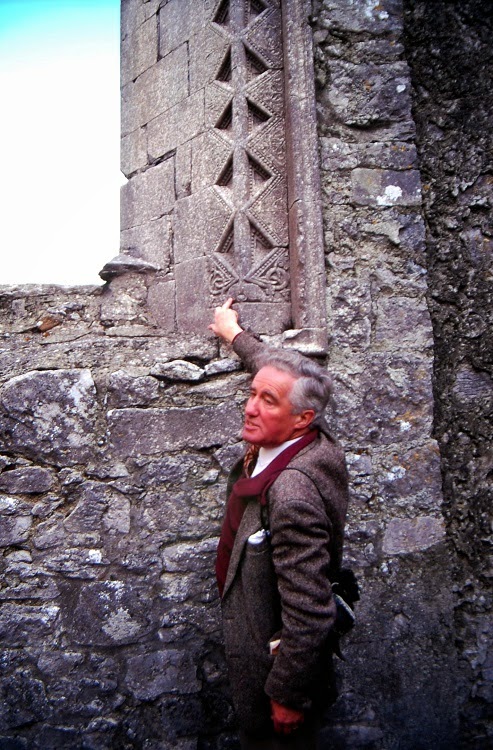
[** If you like this post, please make a donation to the IR&DD project using the secure button at the right. If you think it is interesting or useful, please re-share via Facebook, Google+, Twitter etc. To help keep the site in operation, please use the amazon search portal at the right - each purchase earns a small amount of advertising revenue **] < Part I | Part II Prof. Etienne Rynne at the decorated east window of  Annaghdown Cathedral ,  Co. Galway, in 1996 (© Chapple Collection) In this, the third and final lecture, Prof. Rynne tackles ‘the big three’ of Irish Early Christian metalwork: The Tara Brooch , The Ardagh Chalice , and the Derrynaflan hoard . All of his obituaries noted that he accompanied the Ardagh Chalice to the British Museum when it was disassembled for cleaning and restoration. This gave him remarkable insight into the manufacture of the piece which, unfortunately, he never got around to publishing. While never filling the void, I...

Three Sides Live | Professor Etienne Rynne Lectures | October 1994 | Part II

Image
[** If you like this post, please make a donation to the IR&DD project using the secure button at the right. If you think it is interesting or useful, please re-share via Facebook, Google+, Twitter etc. To help keep the site in operation, please use the amazon search portal at the right - each purchase earns a small amount of advertising revenue **] < Part I | Part III >   Prof. Etienne Rynne speaking at the memorial to the Annaghdown ( Anach Cuan ) boat disaster of 1828 [also: here ], in 1996 (© Chapple Collection) This second lecture given by Prof. Etienne Rynne in 1994 to his class of Diploma students covered illuminated manuscripts. As before, I’ve included an approximate timeline through the lecture with notes on some of the major topics mentioned and his various anecdotes and interactions with the audience. 0:12 ‘I’m going to talk now about the illuminated manuscripts’ 0:25 ‘I haven’t time to talk about Ogham ’ 0:30 ‘Ogham is an impossible ...

Three Sides Live | Professor Etienne Rynne Lectures | October 1994 | Part I

Image
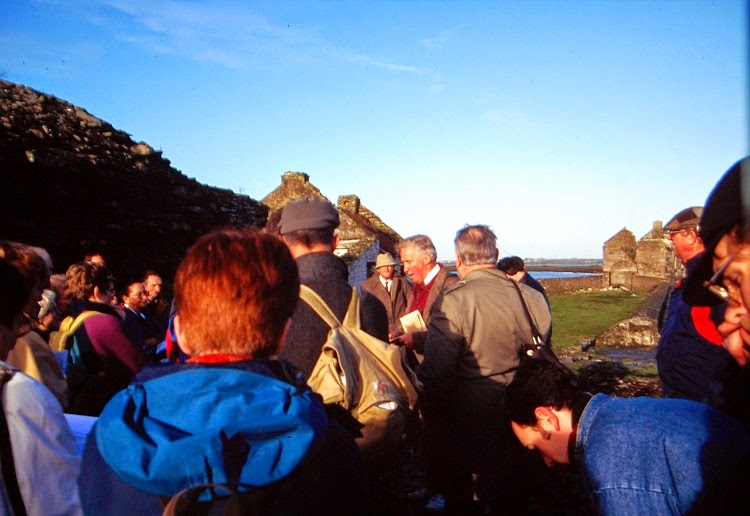
[** If you like this post, please make a donation to the IR&DD project using the secure button at the right. If you think it is interesting or useful, please re-share via Facebook, Google+, Twitter etc. To help keep the site in operation, please use the amazon search portal at the right - each purchase earns a small amount of advertising revenue **] Part II | Part III >   Prof. Etienne Rynne leading a UCG Arch Soc group on Scattery Island , Co. Clare, in 1996 (© Chapple Collection) Prof. Etienne Rynne passed away on the 22nd of June 2012. Since that time I’ve wanted to write something about him for this blog. And herein lies the difficulty: Etienne and I had – to put it mildly – a tempestuous relationship … at times we were the best of friends … and at other times … less so. In the aftermath of his death I thought about putting pen to paper … but what could I write? The appreciation that appeared, from Terry Barry , in Antiquity is fine insofar as it ...