Posts

Showing posts with the label Egyptology

Headless Deity

Image
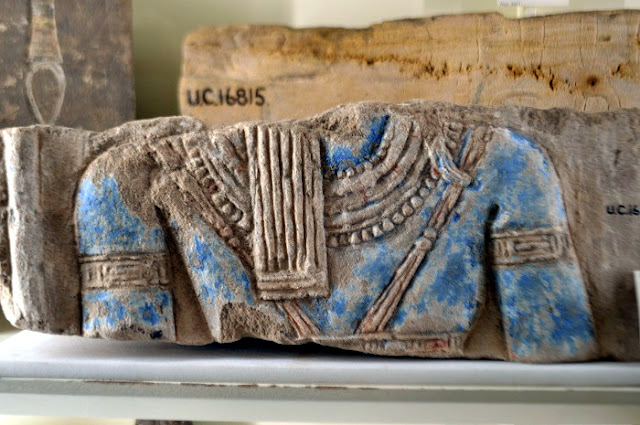
< Table of Contents This fragment of a temple relief from Armant is carved in sandstone and dates to the Ptolemaic period (305 BC to 30 BC). Unfortunately, as the figure is lacking his head it is not possible to identify exactly which deity is represented. Instead, I’m just taken by the fact that this wonderful blue paint has survived so well for over 2000 years.

Palaeolithic Egypt

Image
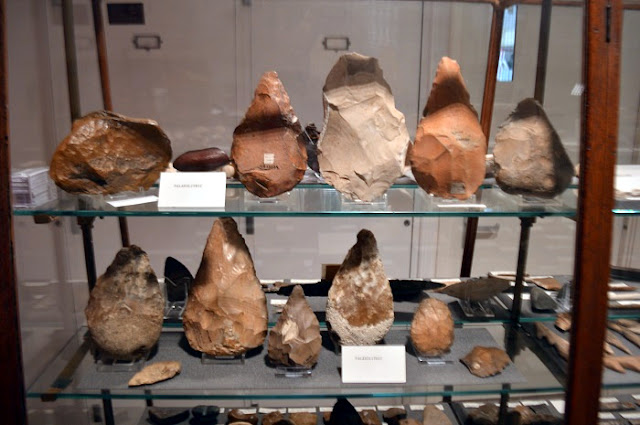
< Table of Contents When we think of the archaeology of Egypt we – almost invariably, but with good reason – get mental images of the Pharaonic period. King Tut, Abu Simbel, Karnak, maybe even Hatshepsut. It’s totally understandable – there are some amazing treasures and buildings from these periods. However, it is still good to remember that – as this case of hand axes reminds us – Egypt had a Palaeolithic past too! 

Head of Narmer

Image
< Table of Contents This limestone head was thought by Petrie to be a representation of Narmer, a king of the 1st Dynasty, considered by many to be the person who first unified Egypt. It’s a gorgeous piece in its own right, with Narmer in his flat-topped headdress, and (from some angles) a somewhat ‘pouty’ look about him. I like it for a whole host of reasons, but one thing that stands out for me is that the museum’s information card (and the Petrie’s online database) note that the piece was purchased in Cairo. It is likely that the piece was originally sourced by ‘treasure hunters’ without regard for its provenance, or any other information that a skilled archaeologist could add to its recovery. On one side is the acknowledgement that purchasing a piece such as this ensured that it was well curated and cared for, but with it must come the realisation that (although acceptable at the time), this created a market that only ensured that further sites were robbed and denude...

Badarian Bowl Burial

Image
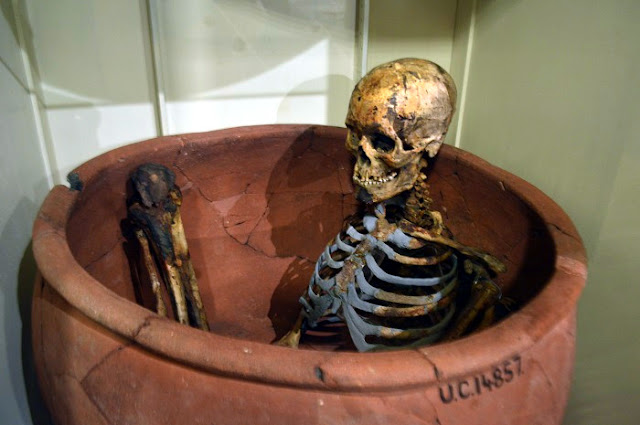
< Table of Contents In an era where the display of human remains has become a contested issue, the presentation of this individual in his burial bowl is particularly arresting. This is the well-known Burial 59 from the pre-dynastic North Spur site at Hemamieh near Badari. The large red earthenware pot contained the deceased individual wrapped in a linen shroud, without grave goods, and was capped by a second, slightly smaller, bowl. The burial is one of a number that cut into the pre-dynastic domestic refuse mound and is tentatively dated to the Protodynastic/Old Kingdom periods. I was particularly taken by the sign near the entrance of the museum that noted that there are human remains on display inside. This is contextualised in terms of how the collections are treated with respect and are the subjects of ongoing research ‘in order to return aspects of their individual identities’.

The Petrie Museum | Overview

Image
< Table of Contents Unlike the other two institutions in this series, I feel that the Petrie may be less familiar to readers and deserving of a dedicated introduction. The Petrie owes much to Amelia Edwards , the successful novelist and passionate Egyptologist. When the department of Egyptology was set up in what is now University College London, the core teaching collection was donated by Edwards. The first Professor of the Department, William Matthew Flinders Petrie , excavated many important sites in Egypt and much of his collection has been preserved here. The author of the Wikipedia article on the museum quite rightly descries it as ‘one of the leading collections outside Egypt’. However, this statement doesn’t really get to the heart of what sets the Petrie apart from other museums. While other institutions may have ‘better’ displays, the Petrie is in a league of its own for displaying material that simply wouldn’t be seen elsewhere – small items, broken items, tiny ...

Archaeology of Gatherings Conference | Institute of Technology, Sligo, Ireland | October 2013 | Part II

Image
[** If you like this post, please make a donation to the IR&DD project using the secure button at the right. If you think it is interesting or useful, please re-share via Facebook, Google+, Twitter etc. To help keep the site in operation, please use the amazon search portal at the right - each purchase earns a small amount of advertising revenue **] The continuing saga of the Archaeology of Gatherings Conference, held in Sligo, in October 2013. < Part I | Part III | Part IV | Part V | Part VI > Modern horse fair ( Source ) Sometime around 11:30, suitably refreshed, we assembled once again for Session 2, chaired by Fiona Beglane. First to the podium was Prof Elizabeth FitzPatrick , ( NUI Galway ) to speak on Shifting Territorial Boundaries and Medieval Assembly Places . FitzPatrick explained that she wanted to concentrate on the Ó enach (pronounced: i-nach) of Lough Gill, Co. Sligo and on how shifts in territorial boundaries could exclude former owners....
A little box full of Egypt: Ancient amulets and Victorian fakes

Image
[** If you like this post, please make a donation to the IR&DD project using the button at the end.  If you like this post, please consider re-sharing this post via Facebook, Google+, Twitter etc.**] If you know me – either in real life or just through my activities online – you’ll be aware (possibly to the point of exasperation) that I’m obsessed with archaeology. You’ll probably also know that my main area of interest is Irish archaeology, especially prehistory, the Early Christian period, and post-Medieval gravestones – it’s just how I am! What fewer of you may know is that I’m also pretty obsessed with Egypt and Egyptology! What almost no one knows is that my family and I are the curators of a small collection of ancient Egyptian artefacts. I say curators, rather than owners, as we believe that we can never truly own such items – we are merely their custodians for the next generation. The collection was passed to me contained in a small Godfrey Phillips tobacco...