Posts

Showing posts with the label Musee de l'Ancien Eveche

Musee de l'Ancien Eveche | Two Capitals

Image
< Back to Table of Contents I have long adored this pair of Romanesque capitals and they form a personal highlight of every visit to this museum. They are carved from a local sandstone known as molasse, and date to the 11th century. They come from a church, now destroyed, in Bocsozel, a small town about 40km to the north-west of Grenoble. As capitals, they would have sat on top of pilasters or columns of some description within the church. The museum's information card doesn't comment as to whether or not there were further carved capitals in the  Bocsozel church. If these were the only two, it's likely they were part of a chancel arch and, thus, in full view of the congregation. One capital is interpreted by the museum as Daniel in the Lion’s Den. Daniel was a Hebrew during the period of the Babylonian Captivity and was sentenced to Death by Lion (Pantheracide? … though that would be the other way around …). Surprisingly, he didn’t get mauled and eaten and...

Musee de l'Ancien Eveche | Panels from an altarpiece

Image
< Back to Table of Contents These two panels come from an altarpiece associated with the chapel of the castle of Bon Repos , Jarrie, just to the south of Grenoble. The castle was built around 1470 by Guillaume Armuet. The panels are oil on wood and are dated to the late 15th or early 16th centuries, making them broadly contemporary with the earliest phase of construction. My understanding is that the surviving panels were positioned at the back of the altar, on either side of a depiction of the Nativity, though this central portion is now lost. The surviving pieces depict Jacob, Patriarch of the Old Testament, and his seven sons. Jacob is shown with a long beard and wearing an elaborate hat. The streaming scrolls, almost reminiscent of a James Gillray cartoon, are intended to show Jacob sharing prophesies with his ‘good’ sons about the coming of Christ and the advent of Christianity. However, shoved over on the right-hand edge is his ‘accursed’ son, Dan – founder of the I...

Musee de l'Ancien Eveche | The Helmet of Chlodomer?

Image
< Back to Table of Contents The helmet as photographed in 2003 This wonderful helmet was found in the 1870s in a peat bog at Saint-Didier, near Vézeronce-Curtin, about 55km to the north-west of Grenoble. It is composed of a gilded copper helm with brass cheek-pieces, and a ring mail neck protection in iron (the leather portions are modern). The helmet appears to be of Byzantine manufacture and was, most likely, owned by a Frankish chieftain. The museum information card dates it to ‘Around 524’ as the find spot was close to the reputed site of the Battle of Vézeronce, fought between the Franks and the Burgundians on June 25, 524 AD. While the battle initially went in the favour of the Burgundians, the Franks turned the tide, albeit with the loss of their king, Chlodomer. The museum’s information card for this piece notes that such a richly decorated item would have belonged to an important individual and dangles the possibility that it may have been Chlodomer’s before sayin...

Musee de l'Ancien Eveche | The parakeet mosaic

Image
< Back to Table of Contents I do love a good mosaic, and I have a particular soft spot for this one from Saint-Romain-en-Gal (Ancient Vienne), approximately 75km to the north-west of Grenoble. In its heyday, it would have adorned a wealthy house and dates to the second century AD. The panel is just over 1m square, and the alternating grey and white borders lead the viewer’s eye to a composition of two birds perched on either side of a two-handled vase (krater) with a jet of water erupting between them. Everything about this composition screams symmetry – two handles, two birds in mirror image, the same number of water streams falling one either side of the central pillar. However, it doesn’t quite work as the main jet of water – that should act as a line of symmetry – is offset ever so slightly (but noticeably) to the right. It simultaneously causes an itch somewhere deep inside my brain while still making me love it all the more. I see different things in this mosaic ev...

Musee de l'Ancien Eveche | The funerary stele of Gaius Papius Secundus

Image
< Back to Table of Contents This funerary stele is dedicated to the memory of one Gaius Papius Secundus, a cavalry officer (decurion) in the city of Vienne, approximately 75km to the north-west of Grenoble. Like the stele of Caius Sollius Marculus, which I discussed in a previous post , this also dates to the second century AD. This example has a triangular pediment containing a carved human head (now very worn) above a garland of some description. Below this, the letters D and M (for ‘Dis Manibus’ ‘To the gods’) are divided on either side of a representation of an ‘ascia’ or adze, a common symbol on steles of this period. The commemorative text is enclosed within a moulded, rectangular frame. Following the museum’s information card, the inscription text is on the left, while the expanded and corrected Latin is on the right: D M D(is) M(anibus). G • PAPIO • SECV G(aio) Papio Secu- NDO • DECVRIO ndo, decurio- NI • C • ...

Musee de l'Ancien Eveche | Coin Hoard

Image
< Back to Table of Contents I find that I am peculiarly drawn to hoards. It’s not just that my childhood imaginings of ‘buried treasure’ endured and survived a career as a professional archaeologist. There’s something fascinating in the way we feel we can see into those moments of deposition, clearly imagining the sequence of events from hurried deposition in advance of an immediate threat, followed by wondering why it was never recovered? Was the one who hid their valuables killed? Were they driven off and never made it back? Did they survive, only to realise that they’d hid their stuff a little too well and couldn’t find it? All of these feelings and questions go through my mind every time I see this pottery vessel stuffed with treasure. The small-value bronze coins are all of the Late Roman Empire and date from 268 to 273. In particular, the hoard is dominated by examples from the reign of Tetricus I (271-274). The collection was discovered in 1979 in Fontanil-Cornil...

Musee de l'Ancien Eveche | Marble Gravestone

Image
< Back to Table of Contents This remarkable little gravestone caught my eye. It was discovered in Drabuyard, Varces, to the south of Grenoble and dates to the 6th century. The upper portion is decorated with a variety of incised cross-forms (one of which bears more resemblance to a snowflake, but you can't have everything) and a little bird. If my guess is correct, the tuft on top of the bird’s head may be enough to identify it as a peacock. Although modern readers will often consider the peacock as an emblem of pride (“Proud as a peacock” and all that), the ancient Greeks believed that its flesh did not decay after death. In this way, it became a symbol of immortality and was adopted by early Christianity. Although fragmentary, the Latin inscription survives sufficiently well to be recorded and translated: [IN H]OCTUMU[LO M]ESERECOR[DIA] [CH]RISTI RE [QUIESC] ET IN [PACE BON] [MEMORIAE] In this tomb by the mercy of Christ, rest in peace, of good memory...

Musee de l'Ancien Eveche | The funerary stele of Caius Sollius Marculus

Image
< Back to Table of Contents As the visitor moves through the basement level of Grenoble’s Musee de l'Ancien Eveche they will pass this rather remarkable funeral stele. It dates to the end of the second century AD and commemorates a tax collector, Caius Sollius Marculus. At this time Grenoble was known as Cularo and contained a tax office specifically for the collection of the “quarantième des Gaules”, a 2.5% levy on all goods in transit. The stele is not simply important for the light it sheds on the financial history of Gaul and the Empire, but it this is the earliest documented reference to the city name: ‘Cularo’. Note: ‘quarantième’ is translated as ‘fortieth’, and one-fortieth is equivalent to 2.5% The stele as photographed in 2003

Musee de l'Ancien Eveche | The Baptistery

Image
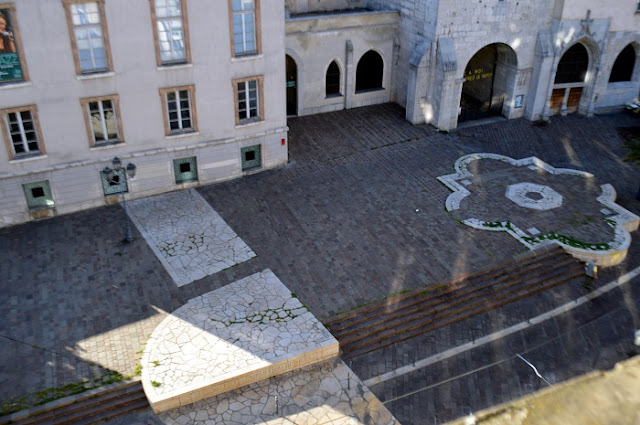
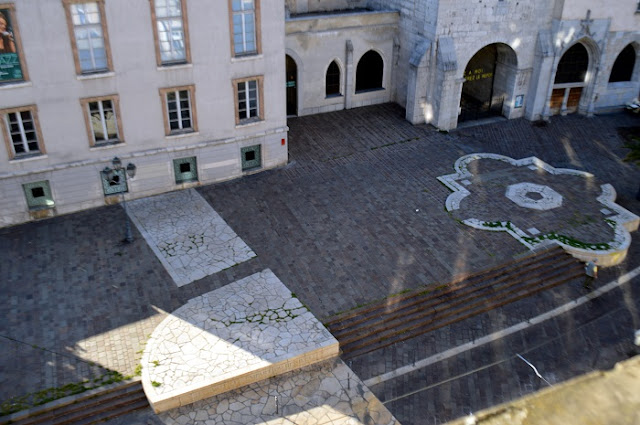
< Back to Table of Contents View of baptistery location from our Airbnb appartment I recently had the good fortune to renew my acquaintance with France. The Chapples were up in the foothills of the Alps for a family wedding, but before we headed home we decided to spend a day in Grenoble. Once safely ensconced in Belfast, I sorted through my photos and put a selection on social media. I was really surprised at the very positive responses I got from a wide selection of friends and acquaintances, so I have attempted to put together a selection for wider distribution. The Musee de l'Ancien Eveche (Old Bishops’ Palace Museum) is a free museum, based (as the name suggests) in Grenoble’s former Episcopal Palace. While it displays and promotes the archaeological and historical past for the whole of the Isère region, I first want to look at the significance of the site itself. In 1989, archaeological excavations ahead of the installation of the tram system uncovered the re...

Grenoble 2017 Table of Contents

Image
To act as an easy way of moving between each of the Grenoble posts, I’ve put together a Table of Contents. The links will go live as each is published. Musee de l'Ancien Eveche | The Baptistery Musee de l'Ancien Eveche | The funerary stele of Caius Sollius Marculus Musee de l'Ancien Eveche | Marble Gravestone Musee de l'Ancien Eveche | Coin Hoard Musee de l'Ancien Eveche | The funerary stele of Gaius Papius Secundus Musee de l'Ancien Eveche | The parakeet mosaic Musee de l'Ancien Eveche | The Helmet of Clodomir Musee de l'Ancien Eveche | Panels from an altarpiece Musee de l'Ancien Eveche | Two Capitals Find the Musee de l'Ancien Eveche | Website | Facebook Grenoble Archaeological Museum | The Church & graveyard Grenoble Archaeological Museum | Madonna & Child Grenoble Archaeological Museum | Doorways Grenoble Archaeological Museum | The Saint-Oyand crypt Grenoble Archaeological Museum | Gravesto...