Posts

The Wreck of La Belle and the archaeology of French Texas

Image
Last November I had the good fortune to be in Austin, TX. Although I was there in my guise of IT guy to attend the Tableau conference, I had a little free time to myself got the opportunity to visit The Bullock Texas State History Museum . Should you get the chance, I would heartily recommend a visit. For those who can’t make it (or need some encouragement to go) I offer this brief collection of posts, showcasing some of the exhibits. To my mind, the premier exhibit in this fascinating museum is La Belle: The Ship That Changed History . The story started in 1684, when Louis XIV sent Robert Cavelier de la Salle off with four ships and 400 people. The plan was to head to North America and establish a colony at the mouth of the Mississippi. The new colony would become the focus of lucrative trade routes and everyone would get rich … very rich! Well … that was the plan … and things didn’t quite go to plan. To be fair, I’m rather stretching the meaning of the phrase ‘didn’t quite...

Working Tools of the 5th Dragoon Guards

Image
Every Masonic Lodge has a collection of what are termed ‘Working Tools’. They are copies of the types of tools used by stonemasons (or ‘operative masons’) and are used in Masonic rituals to teach moral lessons to the candidate undergoing a particular ‘degree’. In most Lodges, these are relatively plain and simple. However, once in a while you see examples like this – in silver, with engraved decoration, and testament to high-quality workmanship. This set of Working Tools in its carrying case, with recessed spaces for each item, originally belonged to Lodge 570. This was a Lodge associated with the 5th (Princess Charlotte of Wales's) Dragoon Guards , constituted under a ‘Travelling Warrant’ in 1863. This set of Working Tools is dated 8th October 1866 and is decorated with the Regimental badge of a trotting horse over the letters DVG. The set is today on display in the museum at that Grand lodge of Ireland, Molesworth Street, Dublin . Entry to the museum is free and is open t...

Burial 40 The Mound of the Hostages, Tara

Image
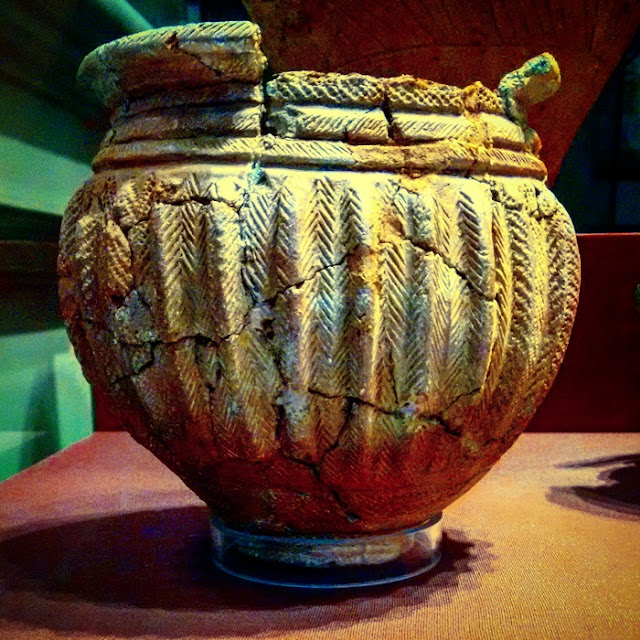
Bipartite vase from Burial 40 at The Mound of the Hostages, Tara, Co. Meath. This burial was represented by a spread of cremated human bone. Analysis indicates that these represented two individuals. Two pottery vessels were associated with the burial – a tripartite bowl & the pictured bipartite vase – along with a flint knife. The burial dates to 2033-1831 cal. BC ( 3600±60 BP ). The artefacts are now housed at the National Museum of Ireland, Dublin.

Inside the Museum: Grand lodge of Ireland, Molesworth Street, Dublin

Image
The last time I was in Dublin I had the good fortune and a little spare time to visit the lovely museum at the Grand lodge of Ireland , on Molesworth Street. The museum aims to give a broad outline of the history of Freemasonry in Ireland, display some of the best regalia, jewels, and artefacts, along with telling the stories of some of the people associated with the Fraternity over the years. The museum is open to the public Monday to Friday throughout the year and (best of all) it’s free! On my last visit, I only had my camera phone available to me, so the quality of the shots is less than astounding. However, I’d like to use this short series of posts to present some of the wonderful items on display there and, maybe, convince you to go take a look for yourself the next time you’re in Dublin!

Bronze Age burials at The Mound of the Hostages, Tara

Image
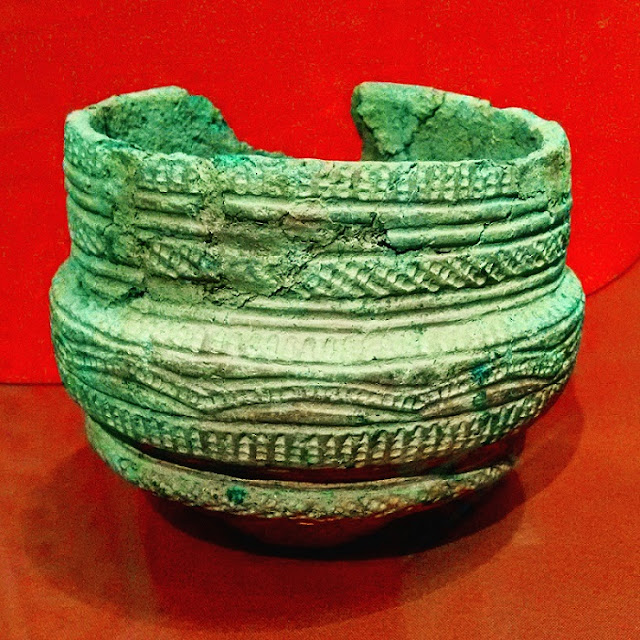
Bronze Age pottery vessels from The Mound of the Hostages, Tara. Housed at the National Museum of Ireland, Dublin.

Inscribed Gravemarker

Image
Inscribed gravemarker made from a reused quern (grinding) stone, 9th-10th century. Commemorates Sechnasach. Found at Clonmacnoise, Co. Offaly, now in National Museum of Ireland, Dublin.

‘The excavation was a financial success’ | Irish Commercial Archaeology in 2015

Image
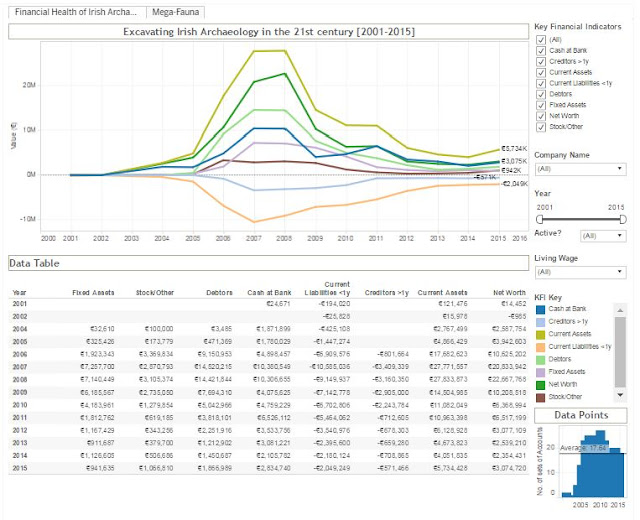
Screenshot of the Tableau Dashboard. Available [ here ] and at the end of this post Background Archaeologists are supposed to be rather good at digging … out in the field it’s quite a bit of what we do. When I left field archaeology in 2011 it was, I suppose, inevitable that I would find something else to delve and dig into. One of the topics that has engaged my attention in recent years is the reconstruction of the financial histories of individual archaeological consultancies to create an impression of the sector as a whole, based on a few publicly available ‘Key Financial Indicators’. The process started with an examination of Northern Ireland’s four archaeological consultancies for the period from 2007-2013 [ here ] and, while imperfect, was sufficient to plot much of the post-2008 collapse of the industry, even if the 2013 data was only for a single company. A second post [ here ] updated the dataset with the 2013 financial details of two further companies. My original p...