Posts

The Becket Casket & thoughts on the ecclesiastical meaning of Louis Vuitton handbags

Image
< Table of Contents The image of a pious archbishop, brutally slaughtered in his own cathedral still resonates almost 850 years after the event. Certainly, the murder of Thomas Becket caused shockwaves throughout the christian world of its day. For all that, I still feel that the clerics of Canterbury were not shy about exploiting the event for the maximum theological and financial gain. Part of the latter must include this majestic casket. Created in Limoges in the period from 1180 to 1190 and decorated with champlevé enamel work, it is the largest, most elaborate, and probably the earliest of the 45 or so surviving examples. The decoration includes scenes from Becket’s killing, burial, and ascent into heaven. The figures on the back are variously interpreted as either saints or personifications of the four Cardinal Virtues (Prudence, Justice, Fortitude, and Temperance). While the intervening decoration on this side is intricate, it and the form of the shrine itself co...

Don’t steal, don’t lift: Thoughts on the consequences of plagiarism

Image
Regular readers of this blog will be aware that a little while back I got into a tussle with a number of senior staff members at University College London and Plymouth University. The short version is that Andrew Bevan, Sue Colledge, Dorian Fuller, Ralph Fyfe, Stephen Shennan, and Chris Stevens (all at UCL) along with Ralph Fyfe (PU) published a paper called Holocene fluctuations in human population demonstrate repeated links to food production and climate in the journal Proceedings of the National Academy of Sciences of the United States of America (PNAS). Unfortunately for me, they neglected to give due credit to the fact that they’d made use of my IR&DD Radiocarbon dates resource (the Catalogue of Radiocarbon Determinations & Dendrochronology Dates ). Unfortunately for them, Andrew Bevan told me about it. I was initially annoyed at what I thought was an oversight, but this was as nothing when I  found that Bevan did not believe he’s done anything wrong. My work was...

Sir Paul Pindar’s house

Image
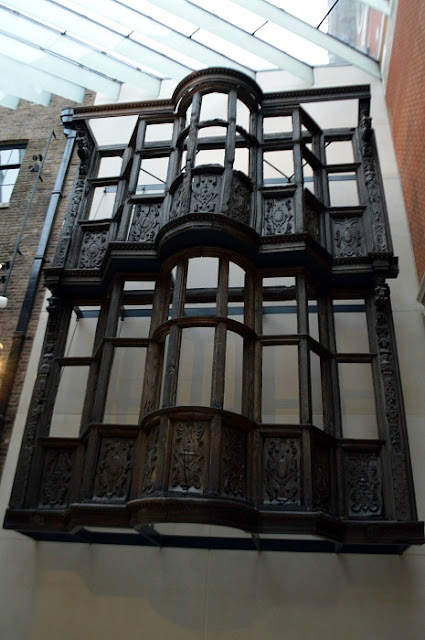
< Table of Contents Sir Paul Pindar (c.1565-1650) was a merchant and was James I’s Ambassador to the Ottoman Empire from 1611-1620. He was eventually Knighted for his service in 1623. As a wealthy merchant-nobleman he appears to have owned a rather fine house, built around 1600. Although subdivided after his death, the portion of the façade on display here is particularly rare for being a timber-framed building in London that survived the Great Fire of 1666. It remained in position until 1890, when it was removed as part of the expansion of Liverpool Street station. I am just in awe of this huge piece and a museum that has the foresight to preserve such a big piece and the audacity to display it in a way that allows it to ‘breathe’ in a gallery. It’s just gorgeous. Sir Paul Pindar's House before being moved to the V&A

Battle Armour

Image
< Table of Contents The two collections of armour that have piqued my interest enough to write about [ here | here ] are both jousting sets, intended for the nobleman at sport. This, however, is an altogether different beast. It is German-made battle armour from around 1570. Intended to be worn in combat, it sought to strike a balance between protection and ease of movement. Although not as ornate as the jousting armour, battle armour could still bear decoration and be quite fashionable and fashion conscious. This particular example is etched with bands of vine scroll, an influence from Islamic art as well as having a narrow waist, mimicking contemporary clothing styles. I can only think that in the heat of battle (and the back plate does appear to have a noticeable ‘ding’) the wearer of this set may have regretted such restrictive fashion choices. As much as I appreciate the quality of the armour, it is the pose that particularly strikes me. There is (to me, at least)...

Hand Reliquary

Image
< Table of Contents For many reasons, I was probably not destined for the religious life. Not the least of these is that on hearing of the passing of a pious and respected elder, my first response isn’t ‘Where did I put that saw?’ However, there is a long tradition in Christianity of chopping off bits of departed clerics to preserve as relics. And when it comes to reliquaries, you’ve just got to hand it to this example! The saintly bits and bobs are long gone, but the reliquary itself survives in amazing condition, even if it was originally intended to be a full arm, rather than just the hand. It was made in the second half of the 13th century, possibly in Belgium. The relics would have been visible through the little ‘windows’ on the fingers. Initially, I thought that these were intended to simulate large, ornamental bezels and stones of finger rings, but their hoops are not continued on the palm side of the hand. This is in contrast to the delicate ring encir...

Three Saints

Image
< Table of Contents This portion of a relief depicts Saints Philip, Jude, and Bartholomew. It was made around 1150 to adorn the western face of the Cathedral of St Peter in Vic, in Catalonia. The first number of times I saw this piece, I merely noted three identical individuals – barefooted, big-handed, and haloed. It was only after some closer attention I realised that each of the three are subtly different, with individualised hair, beards, and clothing. So the viewer (and presumably the apostles themselves) can tell them apart, their names are visible on the books they hold.

Co Donegal: Archaeological Objects at The British Museum

Image
The British Museum holds 18 items identified as coming from Co Donegal, along with one further item identified as coming from either Antrim or Donegal. The majority of these (6) are assigned to the Neolithic/Bronze Age, followed by the Early Medieval (5), and Bronze Age (4) periods. The most common object types are axes, bell-shrines, knives, knives(?)/blades(?), and pins (2 each). Only two material types are represented in this assemblage: Metal (12) and Stone (7). < Table of Contents Neolithic/Bronze Age: Stone items Donegal axe 18900215.100 Polished stone axe, large http://britishmuseum.org/research/collection_online/collection_object_details.aspx?objectId=1392177&partId=1 Letterkenny axe 19890301.143 Polished stone axe with slightly damaged rounded butt. http://britishmuseum.org/research/collection_online/collection_object_details.aspx?objectId=1372130&partId=1 Glenhead knife (?); blade (?) 19641206.217 Flint knife or backed ...