Posts

Hypnos

Image
< Table of Contents There are many reasons to love this piece, but for me I think it’s because it’s a copy of an original, rather than the original itself. This is a bronze head of Hypnos (the personification of Sleep) and is a Roman copy of a Greek original (like so much!). The original is thought to have dated to the period from 325-275 BC and this copy was made sometime between 350-200 BC. We always seem to view copies as inferior products to the original, lacking in imagination, skill, and artistic ability, but this is superb! There is so much life and emotion in theses features that I (at least) frequently see the face in almost exclusively human terms, ignoring the large wing sticking out the side of her head! Although the eyes would have looked very different in antiquity, the way that the shadows now play on their depths never fails to captivate me, offsetting that almost sneering, but eternally alluring mouth ... all of it together telling you that it's late...

Co Longford: Archaeological Objects at The British Museum

Image
The British Museum holds 13 items identified as coming from Co Longford, along with one thought to be from either Longford or Kilkenny. The majority of these (7) are assigned to the Bronze Age generally, followed by the Early Bronze Age and the Early Medieval period (3 each). The most common object type represented are flat axes and spear-heads (3 each), followed by socketed axes (2). All 14 items are made of Metal. < Table of Contents Bronze Age: Metal items Longford spear-head WG.1631 Copper alloy socketed spearhead, pegged. http://britishmuseum.org/research/collection_online/collection_object_details.aspx?objectId=807634&partId=1 Corlea socketed axe WG.1582 Copper alloy socketed axe; cast. Body hexagonal. Five ridges on neck. One haft rib that extends upwards two-thirds of the way to the rim. http://britishmuseum.org/research/collection_online/collection_object_details.aspx?objectId=807571&partId=1 Columbleille spear-head 18630122...

A Ram in a Thicket

Image
< Table of Contents Despite the fact that all the published literature on this piece invariably describes it as a ram, it’s actually a goat … but what’s an ovicaprid between friends? He dates to around 2500 BC and was excavated from the evocatively titled ‘Great Death Pit’ at Ur. He’s one of a pair and the golden tube springing from his neck indicates that he would have originally functioned as support for a table or stand of some description. This goat is simply a masterpiece of craftsmanship. The original core was created in wood with various pieces of gold, copper, lapis lazuli, limestone, and shell, all attached with bitumen. I do like the symbolic combination of themes around nature and fertility, but I’m particularly enthralled by the fact that is still retains a particular ‘goatyness’ … yes, it works beautifully on the level of symbol, but it is still an exceptional rendition of a feeding goat.

Ramesses II (& Belzoni too)

Image
< Table of Contents I’ve wondered how I should start this series. I initially thought that I might leave my very favourite piece to last, but instead I felt that it should be true to how I actually interact with London museums – when I’m in the city I always head for the British Museum first and, within that marvelous complex, I first go see my old friend Ramesses II. This upper portion of a colossal statue is one of a pair from the mortuary temple of Ramesses II in western Thebes, known as the ‘Ramesseum’. The stone for this piece was quarried as a single 20-ton block, far to the south in Aswan and transported here by river. Ramesses is a fascinating character – long lived and a prodigious builder – and, true, some of that is what attracts me to this piece. I love the statue’s serene look, coolly surveying the throngs that come to the museum every day to see him. Even after all these years, I’m still moved by Shelly’s (and, to a lesser extent, Horace Smith’s) ‘Oz...

Co Monaghan: Archaeological Objects at The British Museum

Image
The British Museum holds two items identified as coming from Co Monaghan. One is assigned to the Bronze Age and the other to the Late Medieval period. One is a razor, the other is a seal-impression; seal. Both are made of metal. < Table of Contents Bronze Age: Metal item Monaghan razor 18710321.100 Copper alloy tanged razor. http://britishmuseum.org/research/collection_online/collection_object_details.aspx?objectId=830839&partId=1 Late Medieval: Metal item Ireland seal-impression; seal OA.28 Bronze Abbot's seal-matrix of the Austin Canons Abbey of SS. Peter and Paul, Clones. 14thC http://britishmuseum.org/research/collection_online/collection_object_details.aspx?objectId=47349&partId=1 < Table of Contents

Into the West: Portora Castle

Image
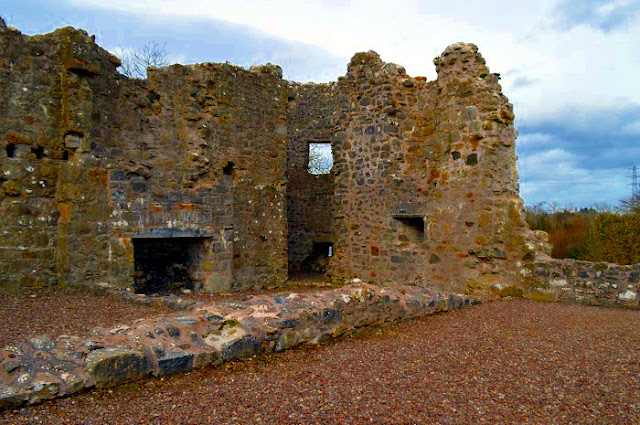
< 3D Images < Table of Contents So far on this trip I’ve gone full prehistoric ( Knockmany ), followed it up with an excursion into the Early Christian and Medieval ( Errigal Keerogue ), but now it was time for a trip into the post-Medieval at Portora Castle. Essentially, I’ve been getting younger as I’ve traveled west. The castle is situated on the banks of the Erne and once controlled access between Upper and Lower Lough Erne. The standing structure was, essentially, four circular corner towers, linked by curtain walling, with a three-story house (two floors with attics) at the west end. Today, one of the corner towers is missing, having been eaten away by the river and the house only survives as a foundation line. The lands here were acquired by Sir William Coles in October 1612 and it is thought that the castle was constructed soon after. At some time before 1621 the site was the residence of a Preacher called Mr Stack. The site was leased or sold on to Bisho...

Into the West: Portora Castle 3D

Image
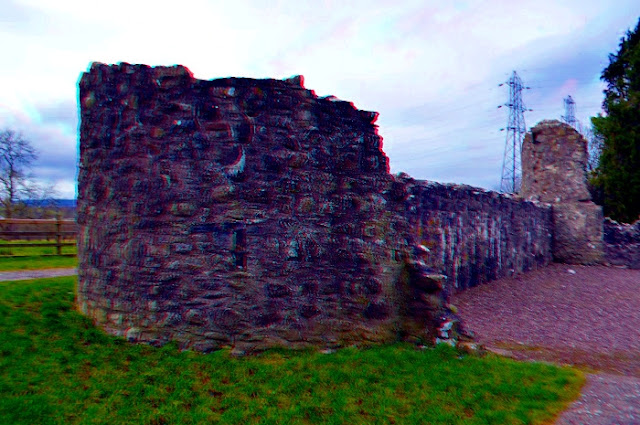
< Back to Main Post < Table of Contents < Back to Main Post < Table of Contents