Posts

Showing posts with the label The Victoria & Albert Museum

‘Bellarmine’ Pottery Vessels and impure thoughts
Image
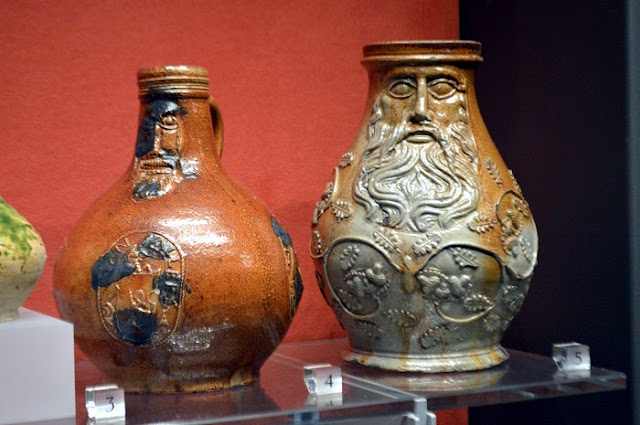
< Table of Contents There is a tendency among some archaeologists, myself included, to describe all and any pottery with a beardy face on it as ‘Bellarmine’. It’s supposed to be named after Cardinal Robert Bellarmine, not for his venomously anti-Protestant views as mocking him for his equally vociferous dislike of alcohol. Somewhere along the way, the name seems to have lost favour and the worthy alternative of ‘salt-glazed stoneware’ just doesn’t have the same ring to it. The jug on the left dates to around 1600 and was made in Frechen, Germany. The three medallions around its waist identify it as having been made for Jan Allers,  a Dutch bottle dealer. The patchy colourtion in blue appears to be the result of a misfiring accident – the bottle may not have come out looking exactly right, but it was still able to serve its purpose. The one on the right is slightly earlier, dating to around 1540, and is from Cologne. The face is beautifully sculpted, being close...
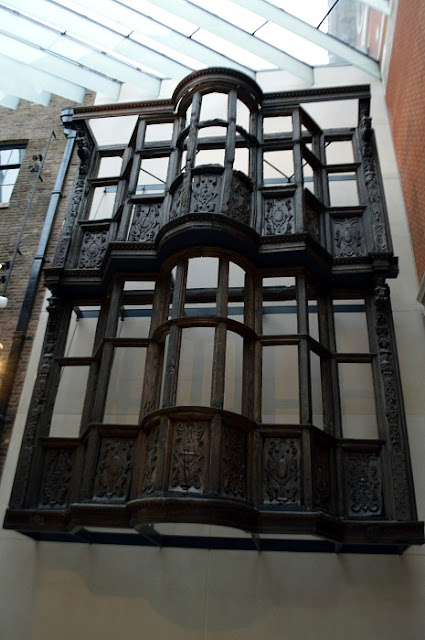
Sir Paul Pindar’s house

Image
< Table of Contents Sir Paul Pindar (c.1565-1650) was a merchant and was James I’s Ambassador to the Ottoman Empire from 1611-1620. He was eventually Knighted for his service in 1623. As a wealthy merchant-nobleman he appears to have owned a rather fine house, built around 1600. Although subdivided after his death, the portion of the façade on display here is particularly rare for being a timber-framed building in London that survived the Great Fire of 1666. It remained in position until 1890, when it was removed as part of the expansion of Liverpool Street station. I am just in awe of this huge piece and a museum that has the foresight to preserve such a big piece and the audacity to display it in a way that allows it to ‘breathe’ in a gallery. It’s just gorgeous. Sir Paul Pindar's House before being moved to the V&A

Battle Armour

Image
< Table of Contents The two collections of armour that have piqued my interest enough to write about [ here | here ] are both jousting sets, intended for the nobleman at sport. This, however, is an altogether different beast. It is German-made battle armour from around 1570. Intended to be worn in combat, it sought to strike a balance between protection and ease of movement. Although not as ornate as the jousting armour, battle armour could still bear decoration and be quite fashionable and fashion conscious. This particular example is etched with bands of vine scroll, an influence from Islamic art as well as having a narrow waist, mimicking contemporary clothing styles. I can only think that in the heat of battle (and the back plate does appear to have a noticeable ‘ding’) the wearer of this set may have regretted such restrictive fashion choices. As much as I appreciate the quality of the armour, it is the pose that particularly strikes me. There is (to me, at least)...

The War of Troy tapestry

Image
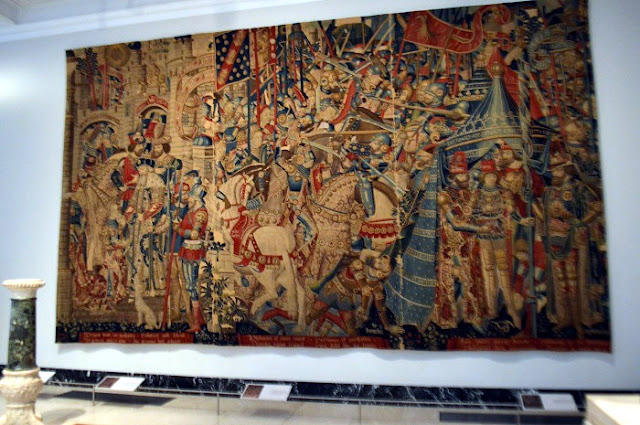
< Table of Contents I just think that this tapestry is marvellous. I could leave that as my only comment on this post and it really would be enough. When it comes to assessing the quality of tapestries, you really only need to know two things. Firstly, the best ones were made in Belgium and, secondly, the high-water mark for production was the 15th century. This example, taking as its subject the Trojan War, sits exactly in that Venn diagram intersection. It was made in the Belgian town of Tournai in the period from 1475 to 1490. In every way, it is the physical manifestation of tapestry making’s ‘sweet spot’. Penthesilea, the Amazon Queen, kneels before Priam, offering her forces to fight against the Greek army. Although we don’t know who this piece was commissioned by, it was in the possession of Charles VIII of France by 1494, when he paid to have work done to it to cover over the heraldic devices of the original owner with his own symbol based around a ray...

Jousting Armour

Image
< Table of Contents I’ve written previously about some rather fine 17th century English jousting armour at the V&A. To provide contrast, the jousting armour in this post is about a century earlier (1520-40) and German. Although all of the pieces that make up this display are from different sets, bequeathed to and bought by the museum at different times, they are unified in their use of decorative fluting. This technique was particularly popular during the reign of Maximilian I, Holy Roman Emperor . As a decorative device, fluting was intended to imitate contemporary pleated doublets, but it also, essentially produces a corrugating effect, strengthening the metal and providing greater protection. This style of helmet (M.2705-1931), known as an armet, first became popular at the end of the 15th century. The hinged visor reduced much of a nobleman’s vision to reduce the risk of facial injury. This was not seen as a particular impediment as, unlike actual bat...

The Three Graces

Image
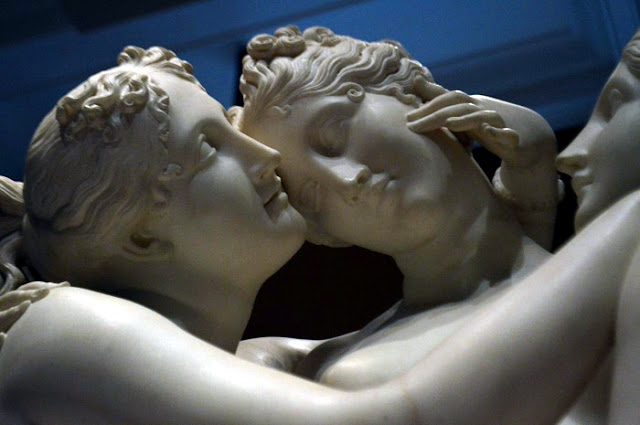
< Table of Contents The Graces are, by tradition, the three daughters of Jupiter/Zeus: Thalia (youth and beauty), Euphrosyne (mirth), and Aglaia (elegance). This group was commissioned by John Russell, 6th Duke of Bedford , when he visited the studios of Antonio Canova in Rome in 1814. There Russell saw and was, justifiably, taken with a version of The Three Graces (now in the Hermitage, St Petersburg) commissioned for Empress Josephine , the former wife of Napoleon Bonaparte. As she had died earlier that year, the Duke made an offer on the piece, but was thwarted by her son, who claimed ownership. Not to be done out of a sculpture, Russell commissioned Canova to produce a second version which was completed in 1817 and installed at Woburn Abbey, Bedfordshire in 1819. One of the reasons I love this piece is the sheer skill demonstrated by Canova. His working technique was to dictate the design and then allow his workers to carve out the broad shapes, saving th...

Half-armour for the tilt

Image
< Table of Contents I’m afraid that I always imagine armour and jousting as being a medieval ‘thing’, rarely realising that even into the early 17th century it was still a popular pastime for the nobility. This rather gorgeous armour was made at the Royal Workshops, Greenwich, when one William Pickering was the Master Workman there, dating it neatly to the period from 1607 to 1618. Rather than being a full suit of armour, this was only intended to cover the upper portion of the rider (thus: ‘Half-armour’).  Here the breastplate has an additional mount to allow for the attachment of a lance-rest.

Adoration of the Kings

Image
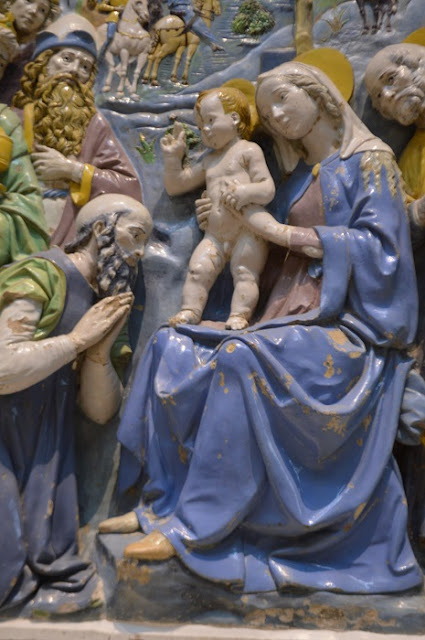
< Table of Contents This altarpiece is made of enamelled terracotta and depicts the adoration of the Magi. It was made by the renowned Italian Renaissance sculptor, Andrea Della Robbia , in Florence and dates to around 1500-1510. The V&A’s database entry for this piece notes that the coat of arms on the lower border indicates that it was commissioned by the Albizzi family. It was most likely intended for an altar at either S Michele or S Andrea at Rovezzano, both of which were patronised by the Albizzi family at that time. I’m always dra wn to this piece for the simple, outlandish gaudiness of the colour scheme. I’m remarkably colour blind and loud colours don’t often resonate, but this thing just screams at me for attention (I can only imagine how gaudy it appears to modern viewers with full colour vision). I  also have to admit that I have something of a soft spot for the Magi. Quite apart from the fact that I memorised the extra-Biblical names o...

The Veroli Casket

Image
< Table of Contents Overview of Casket I’m not entirely sure what it is about ivory carving that I find so attractive, but put me near a well-made example of the art and I start to drool (I’d like to pretend that the drooling was only intellectual, but there may be a physical component too). I do think that part of the attraction must be a reciprocating force to my abhorrence for modern ivory hunting – the ugliness and repugnance of how the material was gathered creating a counterpoint for the beauty of the finished product … and an appreciation of the degree of cognitive dissonance required to reconcile the two positions. In any event, this is considered to be the finest surviving example of ivory carving to have come from Constantinople and dates to the period from 950-1000 AD. The underlying box is of wood, overlain with plaques of both ivory and bone. Close examination reveals that it still retains traces of painted and gilded decoration. Although it is not cle...

Adventures in London museums: Table of Contents

Over the last few years I’ve been lucky enough to get over to London on a number of occasions on my own just to bask in the gorgeousness of various museums. Not doing research on any particular project, just as a tourist out having a look and a poke about. In this series of posts, I want to share some photographs from my excursions to three of my favourites: The British Museum; The Victoria & Albert Museum; and The Petrie Museum. In most cases, my intention is to merely give a few basic details about the piece: the location, provenance, date, that kind of thing. Some will have little snippets of stories to go with them, explaining my fascination with the piece or maybe it won’t. Some of these pieces I consider to be old friends – visited every time I go to the museum – while others are new acquaintances. All of them touched me in some way – intellectually, aesthetically, or emotionally ... sometimes all three … maybe they’ll do the same for you! My intention with this post is...