Posts

Musee de l'Ancien Eveche | Two Capitals

Image
< Back to Table of Contents I have long adored this pair of Romanesque capitals and they form a personal highlight of every visit to this museum. They are carved from a local sandstone known as molasse, and date to the 11th century. They come from a church, now destroyed, in Bocsozel, a small town about 40km to the north-west of Grenoble. As capitals, they would have sat on top of pilasters or columns of some description within the church. The museum's information card doesn't comment as to whether or not there were further carved capitals in the  Bocsozel church. If these were the only two, it's likely they were part of a chancel arch and, thus, in full view of the congregation. One capital is interpreted by the museum as Daniel in the Lion’s Den. Daniel was a Hebrew during the period of the Babylonian Captivity and was sentenced to Death by Lion (Pantheracide? … though that would be the other way around …). Surprisingly, he didn’t get mauled and eaten and...

Musee de l'Ancien Eveche | Panels from an altarpiece

Image
< Back to Table of Contents These two panels come from an altarpiece associated with the chapel of the castle of Bon Repos , Jarrie, just to the south of Grenoble. The castle was built around 1470 by Guillaume Armuet. The panels are oil on wood and are dated to the late 15th or early 16th centuries, making them broadly contemporary with the earliest phase of construction. My understanding is that the surviving panels were positioned at the back of the altar, on either side of a depiction of the Nativity, though this central portion is now lost. The surviving pieces depict Jacob, Patriarch of the Old Testament, and his seven sons. Jacob is shown with a long beard and wearing an elaborate hat. The streaming scrolls, almost reminiscent of a James Gillray cartoon, are intended to show Jacob sharing prophesies with his ‘good’ sons about the coming of Christ and the advent of Christianity. However, shoved over on the right-hand edge is his ‘accursed’ son, Dan – founder of the I...

Musee de l'Ancien Eveche | The Helmet of Chlodomer?

Image
< Back to Table of Contents The helmet as photographed in 2003 This wonderful helmet was found in the 1870s in a peat bog at Saint-Didier, near Vézeronce-Curtin, about 55km to the north-west of Grenoble. It is composed of a gilded copper helm with brass cheek-pieces, and a ring mail neck protection in iron (the leather portions are modern). The helmet appears to be of Byzantine manufacture and was, most likely, owned by a Frankish chieftain. The museum information card dates it to ‘Around 524’ as the find spot was close to the reputed site of the Battle of Vézeronce, fought between the Franks and the Burgundians on June 25, 524 AD. While the battle initially went in the favour of the Burgundians, the Franks turned the tide, albeit with the loss of their king, Chlodomer. The museum’s information card for this piece notes that such a richly decorated item would have belonged to an important individual and dangles the possibility that it may have been Chlodomer’s before sayin...

Musee de l'Ancien Eveche | The parakeet mosaic

Image
< Back to Table of Contents I do love a good mosaic, and I have a particular soft spot for this one from Saint-Romain-en-Gal (Ancient Vienne), approximately 75km to the north-west of Grenoble. In its heyday, it would have adorned a wealthy house and dates to the second century AD. The panel is just over 1m square, and the alternating grey and white borders lead the viewer’s eye to a composition of two birds perched on either side of a two-handled vase (krater) with a jet of water erupting between them. Everything about this composition screams symmetry – two handles, two birds in mirror image, the same number of water streams falling one either side of the central pillar. However, it doesn’t quite work as the main jet of water – that should act as a line of symmetry – is offset ever so slightly (but noticeably) to the right. It simultaneously causes an itch somewhere deep inside my brain while still making me love it all the more. I see different things in this mosaic ev...

Slow Recovery or Extended Death Rattle? Northern Ireland's Commercial Archaeology Sector in 2016

Image
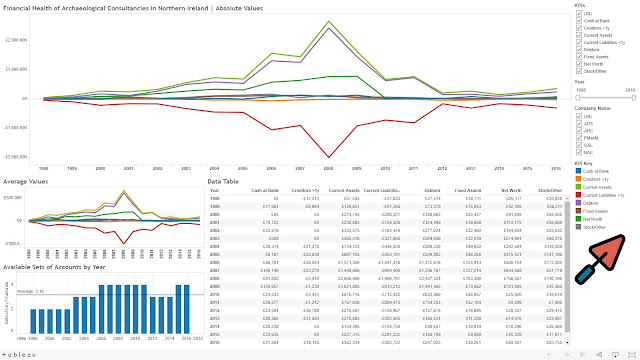
Screenshot of the current state of the Tableau visualisation. Data shown ranges from 1998-2016 The evenings are drawing in and the chill winds whistle around the door. It can only mean one thing! Yes, gentle reader, it’s time to take a look at how Northern Ireland’s archaeological consultancies fared in 2016. As I’ve done before, the data from their end-of-year accounts, submitted to Companies House, has been extracted and used to create an interactive dashboard that the reader can investigate and interrogate at will.   As Archaeological Development Services (ADS) have been dissolved, and play no part in the current archaeological scene in Northern Ireland, we’ll not deal with them further, other than to note that their data remains available within the dashboard. Gahan and Long. All Financial KPIs, 2003-2016 Gahan and Long (G&L) Gahan and Long was formed in 2002 and is run by Chris Long and Audrey Mary Louise Gahan. In 2016 their Cash at Bank increased margin...

Musee de l'Ancien Eveche | The funerary stele of Gaius Papius Secundus

Image
< Back to Table of Contents This funerary stele is dedicated to the memory of one Gaius Papius Secundus, a cavalry officer (decurion) in the city of Vienne, approximately 75km to the north-west of Grenoble. Like the stele of Caius Sollius Marculus, which I discussed in a previous post , this also dates to the second century AD. This example has a triangular pediment containing a carved human head (now very worn) above a garland of some description. Below this, the letters D and M (for ‘Dis Manibus’ ‘To the gods’) are divided on either side of a representation of an ‘ascia’ or adze, a common symbol on steles of this period. The commemorative text is enclosed within a moulded, rectangular frame. Following the museum’s information card, the inscription text is on the left, while the expanded and corrected Latin is on the right: D M D(is) M(anibus). G • PAPIO • SECV G(aio) Papio Secu- NDO • DECVRIO ndo, decurio- NI • C • ...

"Always remember to draw the swastika turning to the right": Some thoughts on swastika directionality in Early Medieval Irish Art

Image
Swastikas are, for a number of reasons, endlessly fascinating symbols. Like all symbols, they are only invested with the meanings we give them. Otherwise they are just little shapes and drawings that mean nothing in and of themselves. Owing to its long history and brief (if traumatic) association with Nazism, the swastika probably has a stronger resonance than most. You won’t spend long on the internet attempting to discuss the swastika before someone, trying to be helpful, notes that the Nazi version rotated counter-clockwise (elbows pointing left) and was bad, but the good Buddhist/Hindu version rotated clockwise. They may be trying to be helpful, but they are invariably wrong. It’s true that the version Adolf Hitler designed for the Nationalsozialistische Deutsche Arbeiterpartei only went one direction: counter-clockwise. What’s wrong is that not all other ( i.e. non-Nazi) swastikas turn the opposite direction (elbows pointing right). Rather than dutifully plod through a debun...